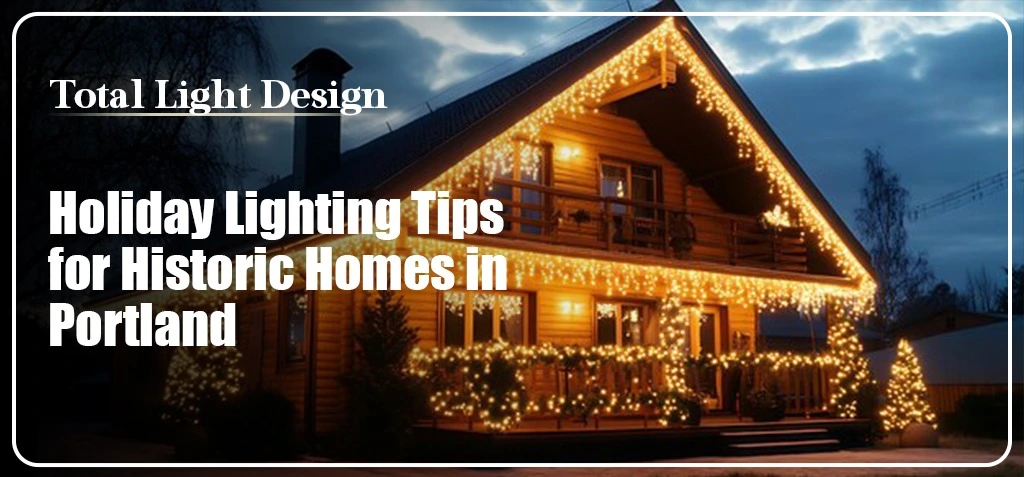
Your historic Portland home has survived decades — maybe even over a century — of Pacific Northwest winters, shifting design trends, and everything in between. The last thing you want is a rushed holiday lighting job to crack a century-old eave, strip original wood trim, or leave nail holes in irreplaceable Victorian millwork.
If you've been searching for professional Christmas Lights Installation in Portland that actually understands the unique demands of older architecture, you're in the right place. At Total Light Design, we specialize in creating stunning holiday displays that honor the character and craftsmanship of Portland's most beloved historic homes — from the stately Victorians of Irvington to the Arts & Crafts bungalows of Ladd's Addition.
Here's everything you need to know before you hang a single strand this season.
Why Historic Homes Require a Different Approach
Most holiday lighting guides are written for new construction — homes with clean vinyl siding, modern gutters, and standard rooflines. Historic homes play by completely different rules.
Original wood siding, hand-carved trim, terra cotta details, and aging masonry need to be treated with care. The wrong mounting hardware can do real, costly damage. Beyond aesthetics, older homes often have outdated electrical systems that weren't designed to handle the load of a full holiday display.
Getting it right means understanding your home first — then designing the lighting around it.
Know Your Home's Architectural Style
Portland's historic neighborhoods are a living museum of architectural styles. Each one has its own character — and its own lighting sweet spot.
Craftsman Bungalows (1905–1930)
These homes are defined by their horizontal lines, wide overhanging eaves, exposed rafter tails, and natural wood details. Warm white C7 or C9 bulbs along the roofline feel perfectly at home here. Avoid anything too flashy or multicolored — it fights the understated elegance of the style.
Victorian and Queen Anne Homes
The turrets, wrap-around porches, decorative gable trim, and layered ornamentation of Victorian homes are made for holiday lights. Outlining architectural details with warm or soft white mini-LEDs creates a look that feels authentically festive without overwhelming the facade.
Tudor Revival Homes
With their steep gabled roofs, half-timbering, and arched doorways, Tudor homes look stunning with lights that trace the roofline and accent the arches. Avoid cluttering the half-timber elements — let the architecture breathe.
Colonial Revival Homes
Symmetry is everything here. Balanced, evenly-spaced lighting along window lines, shutters, and the main roofline honors the home's formal aesthetic.
Pro Tip from Total Light Design:
Before choosing a lighting style, step back and photograph your home from the street. Identify its three or four most distinctive architectural features — those are exactly what your lighting should highlight.
Use the Right Mounting Hardware
This is where most DIY installations go wrong on historic homes.
Standard plastic clips and staple guns can crack original wood trim or leave marks that are impossible to repair. Nails driven into historic siding can let moisture in — a serious problem in Portland's wet winters.
Here's what to use instead:
- All-clip systems — Clips that attach to shingles, gutters, or siding without penetrating the material are ideal for historic rooflines.
- Magnetic clips — Perfect for any metal elements like original tin gutters or decorative metalwork.
- Adhesive hooks rated for outdoor use — On wood trim, these can work for lightweight strands, but test adhesion carefully first.
- Custom ridge and gutter hooks — These distribute weight along the roofline without stressing any single point.
Never use staples, tacks, or roofing nails. On a historic home, every puncture is a potential water intrusion point — and that's before you consider the irreversible aesthetic damage.
Audit Your Electrical System Before You Plug In Anything
Many of Portland's historic homes still have older wiring — some with knob-and-tube or early aluminum systems that simply weren't built for today's loads.
A single holiday display drawing 10–15 amps can trip breakers, damage wiring, or in worst cases, create a fire risk in a home that may have limited electrical protection.
Before your first strand goes up:
- Have a licensed electrician assess your outdoor outlet capacity.
- Identify which circuits your exterior outlets are on — and what else is drawing from them.
- Install GFCI-protected exterior outlets if you don't already have them. They're code-required now for outdoor use and essential in Portland's rainy climate.
- Use LED lights exclusively — they draw a fraction of the power of incandescent bulbs, dramatically reducing your load.
Total Light Design always conducts a pre-installation walkthrough to assess electrical capacity before recommending a display size. It's a step that saves homeowners from serious problems down the road.
Choose Lighting That Complements — Not Competes With — Your Home
The most common mistake on historic homes isn't the installation. It's the light choice itself. Here's a quick guide to what works:
Warm White (2700K–3000K)
This is the gold standard for historic homes. It mimics the soft glow of Edison-era incandescent bulbs and feels period-appropriate on almost any pre-WWII architectural style.
Soft White (3000K–3500K)
A half-step cooler, this works beautifully on Colonial and Tudor Revival homes that have a slightly more formal quality.
Cool White or Daylight (4000K+)
Generally avoid these on historic homes. The blue-toned light clashes with natural wood tones, aged brick, and traditional architectural palettes.
Multicolor Lights
These can work on Victorian homes with their inherently playful, ornate character — but choose vintage-style globe bulbs rather than modern LED multicolor strings. The bulb shape matters as much as the color.
Bulb Size and Style
- C7 and C9 bulbs — Bold, classic, and visible from the street. Great for rooflines on larger historic homes.
- Mini-LEDs — Ideal for outlining detailed trim work, window frames, and porch railings without overwhelming the detail.
- Edison-style globe bulbs — Perfect for porch areas, trees, and outdoor living spaces on Craftsman and Colonial homes.
Design Around Portland's Weather
Portland's holiday season brings rain. A lot of it.
Any lighting on a historic home needs to be weatherproof — not just "weather resistant." This is especially important because older homes may have gaps, aging caulk, and wood elements that are more vulnerable to moisture than new construction.
Key steps to weatherproof your display:
- Use only UL-listed outdoor-rated lights and extension cords.
- Seal all connections with dielectric grease to prevent moisture intrusion.
- Elevate extension cord connections off the ground using cord clips or hooks — avoid letting cords sit in standing water.
- Use outdoor-rated timers to control run times, reducing the hours lights are exposed to rain.
- Inspect connections after the first major rain of the season.
Respect Your Historic District's Guidelines
If your home is in one of Portland's designated historic districts — such as Ladd's Addition, Irvington, or the King's Hill Historic District — you may have additional considerations.
Portland's Bureau of Development Services and the State Historic Preservation Office (SHPO) have guidelines around modifications to historic properties. While seasonal decorations are generally considered temporary and exempt from formal review, permanent mounting systems, electrical modifications, or any changes that affect the exterior fabric of the home should be checked against local guidelines.
Total Light Design is familiar with Portland's historic district requirements and can help ensure your installation stays compliant — and reversible — at season's end.
Plan Your Takedown As Carefully As Your Installation
Historic homes deserve the same care coming down as going up.
- Remove clips slowly and inspect wood trim for any stress marks.
- Store lights in labeled, padded containers — not tangled in a box.
- Check for any moisture damage or gutter debris caused by clip installation.
- Touch up any minor paint scuffs immediately, before Portland's rain gets into exposed wood.
A rushed takedown in January can undo all the careful work of a perfect installation.
Why Professional Installation Makes Sense for Historic Homes
We'll be honest: holiday lighting on a historic home is not the ideal DIY weekend project.
The combination of delicate materials, electrical considerations, weather demands, and the need for historically-sensitive mounting methods makes this a job where professional experience pays off — literally and aesthetically.
Total Light Design works exclusively with residential clients who care about their homes as much as we do. Our team understands Portland's architectural heritage, knows the neighborhoods, and uses only installation methods and hardware that are safe for historic structures.
We also handle full-season maintenance and careful post-holiday removal — so your historic home looks stunning all season, and comes out of the holidays exactly as it went in.
Ready to talk about your home? Contact Total Light Design for a consultation before the season books up.